
A 500kVA Diesel Generator is a major capital commitment for industrial operations. Reliable units typically cost $33,000 to $135,000, with an overall average near $85,000 to $125,000 depending on configuration. This diesel generator buying guide moves you from defining power requirements to comparing quotes. You will work through duty ratings, electrical specifications, components, site configuration, operating data, and RFQ preparation in that order. A practical checklist and FAQ follow, so you can convert requirements into a verifiable quote from any 500kVA generator supplier. Use the same sequence for industrial and commercial projects of every scale.
Define your power needs first. Calculate your real demand and add a 20% margin for growth.
Choose the right duty rating. Prime power runs unlimited hours; standby power caps at 200 hours per year.
Match electrical specs carefully. Confirm voltage, frequency, phase, and power factor (0.8) for your site.
Plan for site conditions. Size fuel storage for your outage length and allow proper clearance for airflow.
Prepare a detailed RFQ. Give all suppliers the same technical inputs to compare quotes line by line.
You cannot size a 500kVA machine from a nameplate alone. Start with the work the site must actually do. A 500 kVA unit delivers up to 400 kW at 0.8 power factor. Match that wattage to your real demand, then add a 20% margin for future load growth and safety. A facility drawing 320 kW, for example, leaves comfortable headroom inside a 400 kW ceiling. This step converts a vague need into a defensible generator size.
The duty rating you choose changes how hard the unit may work and for how long. Compare both ratings before you select any diesel generator.
|
Attribute |
Prime (PRP) – 500 kVA |
Standby (ESP) – 500 kVA |
|---|---|---|
|
Annual operating hours |
Unlimited (up to 8,760 h/yr) |
Max 200 h/yr (incl. 25 h at full power) |
|
Average load factor (24 h) |
≤ 70% of rated power → ≤ 350 kW average |
≤ 70% of rated power → ≤ 350 kW average |
|
Overload capability |
Up to 10% for 1 h within every 12 h |
Normally none specified (brief motor-starting spikes only) |
|
Continuous load capacity |
350 kW average over 24 h, unlimited duration |
350 kW average over 24 h, but capped at 200 h/yr |
|
Design intent |
Variable-load continuous duty |
Emergency/intermittent duty only |
Prime power suits sites that run the machine as their main supply. Standby power fits facilities that need backup during grid outages. The standby rating caps annual runtime at 200 hours, so a site planning weeks of operation needs the prime rating instead. Decide between prime or standby duty early, because the choice drives cost and warranty terms.
Build a load schedule before you talk to suppliers. List every motor, drive, HVAC unit, and control system with its running watts and starting surge. Sum the running figures for your steady demand. Treat the largest motor start as a peak or starting requirement and check that the alternator absorbs it. A load profile built from peak load alone overstates steady demand and inflates the quote. A load profile built from averages alone understates starting surges and risks nuisance trips.
Apply the 20% growth margin to the steady figure, not the surge. Document the resulting load requirements in writing. This record becomes the anchor for every later comparison of kW and kva, voltage, and fuel burn. Review the load schedule once more against planned equipment additions. A clear power requirements statement now saves rework when quotes arrive.
Real power and apparent power describe two different things. Real power, measured in kW, is the work your equipment actually performs. Apparent power, measured in kVA, is the total capacity the generator must carry. Most diesel generators carry a power factor rating of 0.8, and that single number links the two values. You calculate real power as kW = kVA × PF, and apparent power as kVA = kW ÷ PF. A 500 kVA unit therefore delivers 400 kW at 0.8 PF.
|
Parameter |
Calculation |
Result |
|---|---|---|
|
Apparent Power (kVA) |
480 V × 900 A × √3 ÷ 1,000 |
750 kVA |
|
Power Factor |
Standard industry rating |
0.8 |
|
Real Power (kW) |
750 kVA × 0.8 |
600 kW |
Industrial loads such as motors, transformers, and lighting ballasts are inductive and naturally run near 0.8 lagging. Keep both limits in view. A set rated 1000 kW and 1250 kVA can run above 80% PF as long as neither rating is exceeded. Dropping below the rated PF overloads the windings even when the engine carries a light load. Compare kw and kva on every quote, not just one figure.
Confirm voltage, frequency, and phase against your distribution system before you finalize any order. Modern diesel generator lineups come in both 50Hz and 60Hz configurations, so state your grid standard up front. A 60Hz unit will not serve a 50Hz site without consequences for motor speed and connected equipment.
Walk the site and record four items. Note the service voltage and phase configuration. Measure ambient noise at the proposed location and set a dB limit for the enclosure. Estimate fuel storage capacity against your expected outage length. Identify the nearest service support and parts network. These site electrical requirements decide the final configuration, and they belong in writing before you request pricing. Confirm voltage, frequency, and phase with your utility and your equipment nameplates, then hand the verified list to each supplier.
Base every selection on documented performance data, not on reputation alone. Industrial diesel generator models may be powered by engines such as MTU, Baudouin, or RICARDO depending on capacity and frequency. Ask your diesel generator supplier for the engine datasheet, the alternator efficiency curve, and the fuel map for the exact model you intend to buy. These documents let you verify that the engine and alternator requirements match your load schedule, including motor-starting surges.
Check the alternator's insulation class, temperature rise, and short-circuit capability against your site conditions. Confirm that the engine's rated output at your altitude and ambient temperature still covers the 400 kW ceiling of a 500 kva unit. A supplier who cannot produce these documents for a specific model has not given you a verifiable offer.
Treat the controller as a selection criterion in its own right. Modern controllers combine protection and monitoring, with overcurrent protection, reverse power protection, and loss of synchronization detection that disconnect the set automatically during a fault. Load sharing and parallel operation control distribute load across paralleled units and prevent overloading of any single machine. Frequency and voltage regulation rely on feedback loops, governors, and automatic voltage regulators to hold power quality as load varies.
Communication options matter for remote sites. Look for CAN Bus, J1939, RS485, Modbus, and RS232 interfaces, plus analog and digital inputs for fuel senders, pressure switches, and alarm contacts. Synchronization performance targets give you a benchmark: frequency matching within ±0.1 Hz, voltage regulation within ±2%, phase angle difference below 10 degrees, and frequency stability within ±0.5% during transients. Evaluate smart monitoring, emissions control, and noise reduction as criteria in their own right. The controller, enclosure, tank, ats package should then be specified together, so the monitoring system, weather protection, fuel storage, and transfer switching work as one integrated system rather than four separate purchases.
Fuel storage sizing starts with the burn rate at your expected load. A 500 kW diesel generator at 75% load consumes about 26.9 gallons per hour.
|
Load Level |
Fuel Consumption (gal/hr) |
|---|---|
|
50% load |
18.5 |
|
75% load |
26.9 |
|
100% load |
35.7 |
A 24-hour outage at that load needs roughly 645 gallons. A 1,500-gallon tank supports extended multi-day operation at high load. NFPA 110 requires Level 1 systems to store enough fuel for their assigned class runtime, commonly 48 or 96 hours, with tanks sized at 133% of calculated demand. Size from the 100% load column even when you expect lighter operation. For critical sites, plan at least 24 to 72 hours of continuous runtime plus a 20% safety margin.
Enclosure choice follows the site. Weather-resistant, sound-attenuated enclosures protect internal components from dust, moisture, and corrosive byproducts while limiting acoustic impact. Specify the controller, enclosure, tank, ats as one integrated package. The automatic transfer switch handles automatic transfer between utility and generator sources, so confirm its rating matches your service.
Plan clearance and airflow before the unit arrives.
|
Requirement |
Recommendation |
|---|---|
|
Clearance from flammable materials |
Minimum 5 feet (1.5 m) |
|
Ventilation space around unit |
At least 3 feet (1 m) on all sides |
|
Inlet and exhaust port clearance |
At least 5 feet from walls or obstructions |
|
Combustible clearance |
6 to 18 inches, using flexible joints |
Keep intake vents unobstructed and route exhaust outdoors through insulated, corrosion-resistant piping. The outlet must not face building air inlets or pedestrian areas. Indoor installations typically need fan-assisted intake and discharge, interlocked with the generator controller so ventilation runs before engine start. Verify clearance zones around the 500 kva unit for routine maintenance access. Install carbon monoxide detectors near the unit and follow local codes.
Fuel burn rate drives your operating cost during long outages, so treat it as a line item in every comparison. Ask each supplier for the fuel map at 50%, 75%, and 100% load, then multiply those figures by your expected outage hours and local fuel price. Two quotes with similar purchase prices can diverge sharply over a multi-day event. Match the burn rate to your load profile rather than the nameplate rating, because a lightly loaded set wastes fuel per delivered kilowatt-hour. Larger models such as the ON-M3000P MTU 20V4000 G63L Generator publish full consumption curves, and you should demand the same documentation for any 500 kVA unit you shortlist.
Nameplate ratings apply at ISO 3046-1 reference conditions: 100 kPa, 25 °C, and 30% relative humidity. Thinner air at elevation and higher ambient heat reduce combustion efficiency and cooling capacity, so the available output falls below the nameplate figure. A common approximation is roughly 4% output loss per 1,000 m above sea level, which would take a 500 kVA set to about 420 kVA at 4,000 m. Use that rule for early screening only.
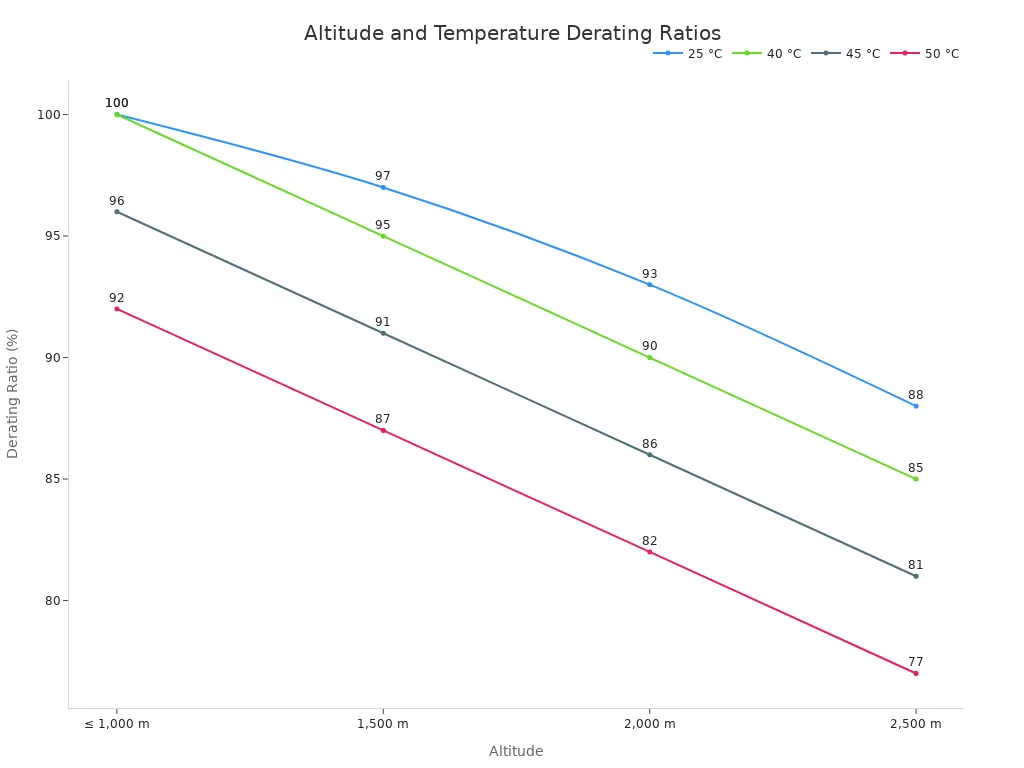
|
Altitude \ Ambient Temp |
25 °C |
40 °C |
45 °C |
50 °C |
|---|---|---|---|---|
|
≤ 1,000 m |
100% |
100% |
96% |
92% |
|
1,500 m |
97% |
95% |
91% |
87% |
|
2,000 m |
93% |
90% |
86% |
82% |
|
2,500 m |
88% |
85% |
81% |
77% |
Work the numbers backward from your site. At 1,500 m and 45 °C, an engine ratio of 91% means 400 kW ÷ 0.91 ≈ 440 kW, and an alternator ratio near 94% means 500 kVA ÷ 0.94 ≈ 532 kVA. That points to a 550 kVA class unit. The most restrictive of engine, cooling, and alternator limits governs the final selection.
"There is no fixed ratio; it varies with the engine, turbocharging system and power rating. Many data sheets give full power up to a certain altitude and, above it, define a percentage reduction for every hundred or few hundred metres. For the correct value, check the derating curve of the engine concerned."
Confirm the derating curve for your exact model with the supplier in writing. A diesel generator sized for standby power at sea level may fall short of prime duty on a hot, high site.
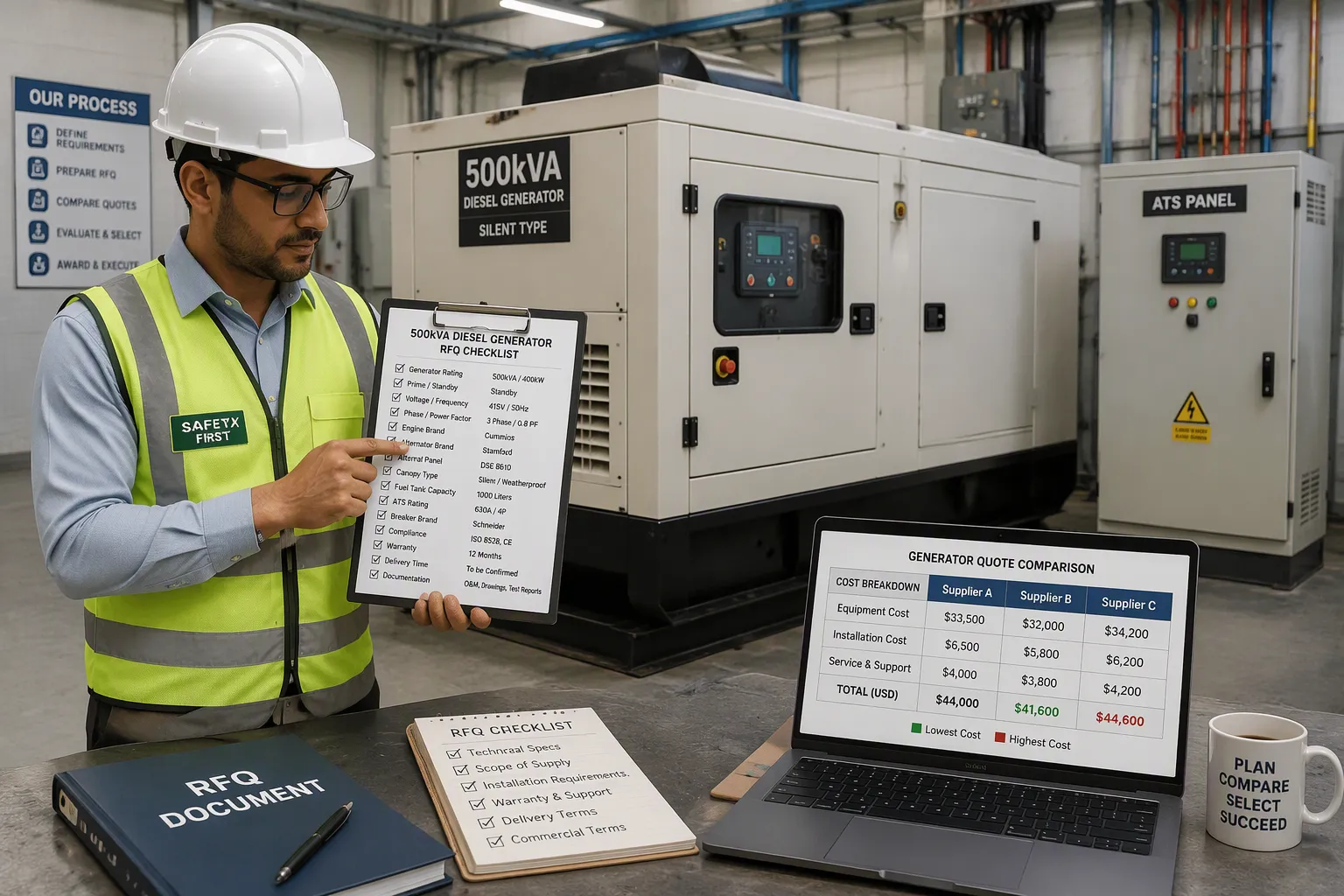
A well-built diesel generator rfq turns a conversation into a comparison. Give every supplier the same technical inputs, and the quotes will line up line by line. Start with the power rating: state the kva figure and the duty class, prime or standby. Add the electrical parameters — voltage, frequency, phase, and engine speed (1,500 rpm for 50 Hz, 1,800 rpm for 60 Hz). Then describe the enclosure type, IP rating (IP21–IP54), and sound pressure level at 7 m. Name the emission stage and the certifications you require, such as CE, ISO 8528, ISO 9001, or NFPA 110. Attach your load schedule so the supplier sizes against real demand, not a guess. Record site conditions: installation altitude, maximum ambient temperature, and autonomy requirement. Specify base tank capacity or an extended day tank, alternator insulation class (H) and IP rating, and any ATS, remote monitoring, or paralleling options. Close with commercial terms — delivery Incoterm, destination port, quantity, and warranty wording. Ask the supplier to mark every assumption and configuration-dependent item. That single instruction exposes hidden variables before they reach the price.
An industrial generator price quote bundles several purchases into one number. Separate them before you compare. Equipment, installation, and service support each carry their own cost drivers. Engine brand, canopy acoustic insulation, alternator copper winding grade, and ATS automation move the equipment figure most. A soundproof canopy unit costs roughly 15–22% more than an open-type unit. Factory-direct purchasing can reduce the 500kVA generator price by 20–30% by removing dealer markups and broker commissions.
|
Cost Component |
Low End |
High End |
|---|---|---|
|
Equipment (silent canopy genset) |
$28,000 |
$180,000 |
|
Concrete pad and foundation |
$8,000 |
$25,000 |
|
ATS and electrical interconnection |
$25,000 |
$50,000 |
|
Fuel storage (external tank system) |
$8,000 |
$50,000 |
|
Exhaust and ventilation |
$5,000 |
$15,000 |
|
Permits, inspections, and commissioning |
$2,000 |
$10,000 |
|
Total Project Cost |
$76,000 |
$330,000 |
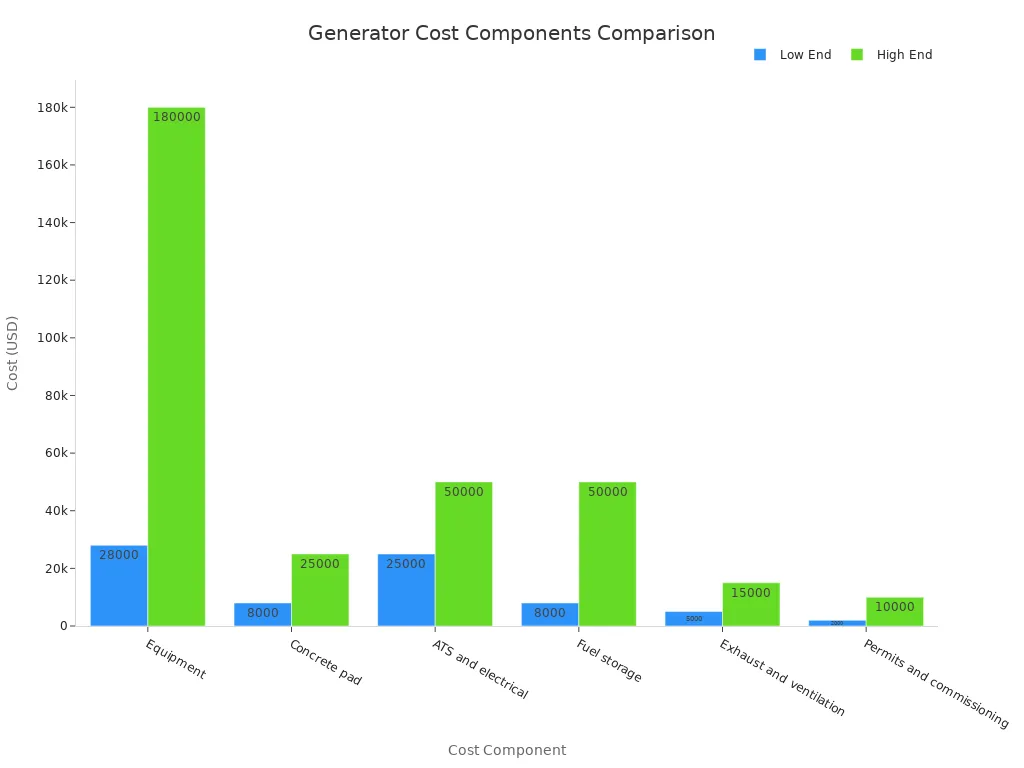
A contractor budgeted $38,000 for a factory-direct 500 kW silent genset but had not budgeted for an $18,000 reinforced concrete pad, $32,000 ATS and electrical integration, a $22,000 fuel tank system, and $8,000 in customs duties and port handling — nearly tripling the "generator price" before the unit produced a single kilowatt.
Request documentation for every performance claim from each 500kVA generator supplier. Ask for the Declaration of Conformity, a Technical File index, and test reports citing EN ISO 8528-13:2016. Confirm the documents name your exact model and rating. Verify the issuing body through the EU NANDO database, and check the nameplate against the DoC. A comparable diesel generator rfq demands the same paper trail from every bidder. Confirm the factory load-bank tests every unit at 100% rated output. That evidence separates a verified offer from a hopeful one.
Both paths can serve an industrial site well. A new unit brings a full warranty, current emissions compliance, and a known service history from day one. A new diesel generator such as the MTU 16V4000 G63 1840kW Generator also arrives with factory test documentation. A used unit can suit budget-constrained or temporary projects, provided you verify it carefully. Neither path is inherently better; the right fit depends on your runtime plan, capital limits, and tolerance for inspection work.
Verification separates a sound purchase from a costly gamble. Work through these steps when buying used industrial generators:
Verify total operating hours, not just age. Industrial diesel engines are typically built for 15,000–20,000 hours, and under about 5,000 hours is generally considered low-usage. A 10-year-old unit with 500 hours differs greatly from one with 8,000 hours.
Understand the previous usage pattern. Standby units run only for monthly tests and typically show less wear than prime-power units run continuously.
Review maintenance records and service intervals. Industrial engines need service every 250–500 operating hours, and each service typically costs $800–$2,000. Confirm regular oil changes, filter replacements, and inspections.
Demand a load bank test. Run the unit at 75–100% capacity to confirm stable voltage and frequency, proper engine temperature, correct oil pressure, and clean exhaust.
Buying used industrial generators without that test leaves performance unproven. Buying used industrial generators from sellers who withhold records carries the same risk.
A used industrial generator earns its place in specific situations. The table below shows where each scenario fits.
|
Scenario |
Why a Used Unit Fits |
|---|---|
|
Short-term or temporary applications (construction sites, events, defined-endpoint projects) |
Avoids paying a new-unit premium for brief use |
|
Budget-constrained situations with limited capital expenditure |
Lower upfront cost, with close monitoring |
|
Well-documented, low-hours units from reputable sources |
Full service records, recent load bank test data, and runtime under ~5,000 hours on a major brand engine |
|
Backup redundancy (secondary or tertiary unit) |
Another generator provides primary reliability |
Match the scenario to your site before you commit.
You now have a clear path from requirements to a signed order. Define your load profile and duty rating first. Match electrical specifications next, then select engine, alternator, and controller. Configure the site, verify operating data, and build a comparable RFQ. Each step feeds the next, so a diesel generator quote reflects verified demand rather than guesswork.
Turn your notes into a quote request with this checklist:
State the kVA rating and duty class, prime or standby power.
Attach the load schedule and the 20% growth margin.
List voltage, frequency, phase, and enclosure IP rating.
Record altitude, ambient temperature, and required runtime.
Request fuel curves, derating data, and test reports.
Send the same package to more than one 500kVA generator supplier. Compare the returned proposals line by line. Plan maintenance intervals and lifecycle cost before you sign, because long-term ownership spending shapes the true purchase decision.
A 500 kVA unit delivers 400 kW at a 0.8 power factor. You calculate real power as kW = kVA × power factor. Confirm both the kW and kVA ratings on every quote, because the alternator must carry the apparent power while the engine carries the real load.
Fuel burn tracks load, not nameplate size. At 75% load, a 500 kW set consumes about 26.9 gallons per hour. A 24-hour outage at that load needs roughly 645 gallons. Request the fuel map at 50%, 75%, and 100% load from each supplier.
Only with the correct duty rating. A prime-rated unit supports unlimited annual hours at up to 70% average load. A standby-rated unit caps runtime at 200 hours per year. Choose prime power when the generator serves as your main supply rather than backup.
Plan at least 5 feet (1.5 m) from flammable materials and 3 feet (1 m) of ventilation space on all sides. Keep inlet and exhaust ports at least 5 feet from walls or obstructions. Route exhaust away from building air inlets and pedestrian areas.
Verify total operating hours, the previous usage pattern, and complete service records. Demand a load bank test at 75–100% capacity to confirm stable voltage, frequency, and oil pressure. Industrial engines typically run 15,000–20,000 hours, so low-hour units with documentation fit best.
 NO.107 XIYUAN ROAD ,JINAN District,FUZHOU CITY, FUJIAN,CHINA
 E-mail: jina@onewpower.com






Stay Connected
 |
Sitemap
|
Xml
|
blog
|
Privacy Policy
 English